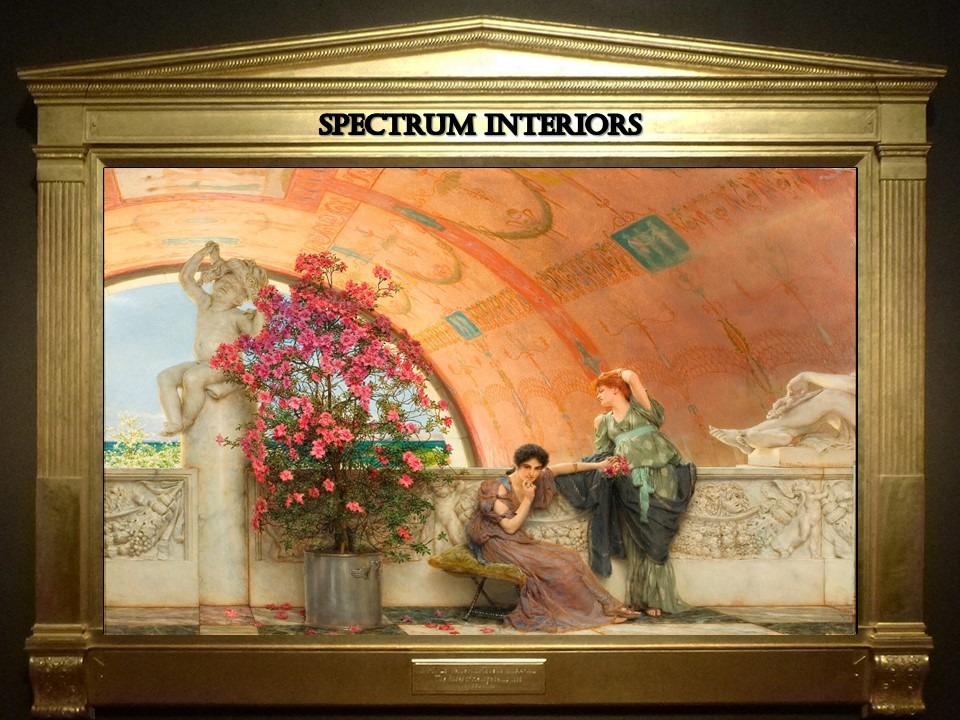
The Steven C. Adamko Interior Design Philosophy & Manifesto
Steven C. Adamko — Founder, Spectrum Interiors (est. 1982)
The Interior Design Philosophy of Design Beyond Appearance
Interior design is often approached as a purely visual discipline—defined by furniture, color, layout, and style. While these elements are important, they represent only part of the story. From the very beginning, even before my formal training, I recognized a principle that continues to guide my work: interiors are not just visual spaces; they are emotional environments. You don’t live in how a space looks—you live in how it feels.
The Missing Element: Ambiance
Over the years, I’ve encountered many interiors that were visually correct—well-furnished, thoughtfully styled, even striking at first glance—yet something essential was missing. These spaces felt “off,” not because of any obvious flaw, but because they lacked a deeper quality. That quality is what I call Ambiance: the emotional experience of a space. It’s the feeling you sense the moment you enter a room, before analysis begins and before details are consciously noticed. Ambiance cannot be reduced to style or created through decoration alone. At the same time, it does not exist independently of design—it is the result of it.
Structure and Ambiance
The structural elements of design—balance, proportion, scale, form, and composition—are more than visual tools; they are the foundation that makes ambiance possible. Without structure, a space lacks clarity. Without ambiance, it lacks meaning. The two are inseparable, working together seamlessly.
A Different Approach
This perspective sets my approach apart from much of what is commonly presented as interior design today. Too often, emphasis is placed solely on appearance—trends, finishes, and surface styling. But appearance without intention produces spaces that may look complete yet feel unresolved. Conversely, focusing only on mood without structural discipline leads to environments that lack coherence. Neither approach, on its own, is sufficient.
What Great Design Requires
Great design requires both structure and sensitivity, discipline and awareness, skill and care. In simple terms, quality is never accidental; it is the result of thoughtful, intelligent effort. When that effort is guided by a clear understanding of how a space should feel, the environment begins to truly support those who inhabit it. It becomes easier to move through, easier to relax in, and easier to experience.
The Goal
That is the ultimate goal—not merely to create something that looks good, but to create something that feels right. This requires the right interior design philosophy.
Spectrum Interiors
This philosophy has guided my work at Spectrum Interiors since 1982. Whether designing an interior, developing a lighting plan, or crafting custom furniture, the objective remains consistent: to bring structure and ambiance into alignment. When form and feeling support one another, a space becomes complete.
A Unified System of Practice
The SKP Method™, the Design Ambiance Method™, and my Interior Design Philosophy are not separate ideas. They are not independent approaches. They are interrelated expressions of a single design intelligence.
Each one has a distinct role. Each one performs a specific function. Yet in practice, they do not operate alone. They operate together—simultaneously, continuously, and in real time—as a dynamically synergistic system that defines how I think, how I see, and how I create.
The SKP Method is the perceptual foundation. It is the integration of Skill, Knowledge, Passion, Insight, Wisdom, and Judgment. It is not a collection of traits—it is a unified way of seeing and deciding. It governs how I see beyond the present state of a space and into its completed form. It is what allows the finished environment to be recognized before it exists, and held with clarity as every decision is made.
The Design Ambiance Method is the translation of that perception into built reality. It is built upon what is defined in advance: Feeling, Emotion, and Ambiance. These are not afterthoughts. They are established at the outset and then interwoven throughout the entire design. They guide every decision and shape the experience of the space at every level. Every structural and sensory decision carries both a visual and an atmospheric consequence.
The visual look and the felt emotional ambiance are not developed separately. They are fused together—continuously and deliberately—to form an orchestrated whole.
Like a masterful piece of music, every element has its place, its timing, and its purpose. Nothing stands alone. Nothing is arbitrary. Everything works together to create a complete and unified experience.
My Interior Design Philosophy is the governing truth that holds everything together: that interiors are not objects to be viewed, but environments to be experienced. Structure and ambiance are inseparable. One creates clarity. The other creates meaning. Together, they define the reality of a space.
These are not sequential steps. They are simultaneous functions.
I operate across all three levels at once—perceptual, structural, and experiential—without separation between concept, execution, and outcome. From the earliest moment of vision through final realization, alignment is maintained. This is My Interior Design Philosophy That I Never Deviate from.
This is not a step-by-step process. It is a continuous state of orchestration—where the completed environment is already known, already felt, and continuously refined as it is brought into physical form.
Together, these three systems form a unified way of working that is not theoretical. It is operational. It defines how I design. How I decide. And how I bring environments into existence.
Because in the end, you don’t live in how a space looks—you live in how it feels. It is My Interior Design Philosophy of The Right Aesthetics Plus the Right Ambiance. I is the Interior Design Philosopy that I have developed from the very beginning of my career.
— Steven C. Adamko, Interior Designer, NCIDQ
The Architect of Ambiance.
The Builder of Beauty.
The Designer of Distinction.